

Security camera types describe different things: the housing, how the camera moves, its lighting, and how it connects. A bullet camera can also be a PoE camera with infrared night vision, while a doorbell camera can use Wi-Fi and battery power.
Start with the area you need to see and the detail you need to record. A fixed view of a doorway, an overview of a large room, and readable license plates each call for a different setup.
The 20 categories below overlap. Use the shape to plan mounting, then check the actual lens, power source, recording options and outdoor rating.
I explain 20 different camera types and their typical uses below. For model-by-model detail, see our security camera comparisons and specific camera guides.
Which Camera Type Fits Your Space?
For a doorway or narrow approach, start with a fixed bullet, turret or dome and a suitable lens. For a whole-room overview, consider a fisheye or multi-sensor camera. Use PTZ for a controllable close-up, and thermal imaging when heat-based detection is the task.

Power and connection are separate choices. PoE carries network data and power over compatible Ethernet equipment. Wi-Fi still needs a battery, adapter or another power source. Check that recording works where you need it, including during an internet outage if local recording is important.
1. Bullet Cameras

Bullet cameras are compact, high-visibility cameras often equipped with weather-resistant features.
I start off this list with one of the most popular types; the bullet security camera. Aptly named for their cylindrical shape, bullet cameras are a popular choice for various surveillance needs due to their compact design and versatile features.
Bullet cameras are known for their high visibility to help deter criminals. They can be mounted on to walls or ceilings.
Additionally, many bullet security cameras come equipped with weather-resistant housings, ensuring that your surveillance remains effective regardless of the environmental conditions.
Overall, bullet cameras provide a reliable and straightforward solution for monitoring your property, deterring criminal activity, and ensuring peace of mind.
2. Turret Cameras

Turret cameras have an adjustable eyeball-style housing. They can suit indoor or outdoor installations, depending on the model.
With their compact design, these cameras can be manually pivoted and rotated with ease, making installation a little easier.
For an outdoor turret, check its stated ingress-protection rating and operating temperature. The housing shape alone does not establish weather resistance.
Additionally, their discreet design makes them less noticeable, allowing for better surveillance without attracting unwanted attention.
Turret cameras often come with advanced features such as night vision and motion detection, further enhancing the security and efficacy of your surveillance system.
3. Dome Cameras

Dome cameras place the lens behind a protective clear or tinted dome. The cover can make its direction less obvious, although that depends on the design and viewing angle.
This design not only offers an aesthetically pleasing and low-profile appearance but also provides an added layer of ambiguity, making it harder for potential intruders to avoid detection.
Check out this great video by IC Realtime that compares the first 3 types of cameras on this list:
Check the dome camera’s actual outdoor and impact ratings before choosing a location. Keep the cover clean: dirt, scratches and nearby surfaces can reflect built-in infrared light back toward the lens.
4. PTZ Cameras

PTZ security cameras, or pan-tilt-zoom cameras, offer a versatile surveillance solution by allowing the user to remotely control their movement and zoom capabilities.
These cameras can pan horizontally, tilt vertically, and zoom in on specific areas, providing wide coverage and detailed views of monitored spaces.
A PTZ camera suits active viewing and following activity in a large area. When its lens points toward one target, other directions can be outside the recorded view.
For continuous coverage of several entrances, use fixed cameras or a panoramic overview alongside the PTZ. An automatic patrol visits positions in turn; it does not record every direction at once.
Related article: Best Wireless PT/PTZ Security Cameras (Indoor & Outdoor)
5. PT Cameras

Pan-Tilt (PT) security cameras offer flexible motion capabilities for monitoring expansive spaces.
These cameras lack the optical zoom function commonly found in their PTZ counterparts and are generally found in indoor settings with functions like pet or nanny cams.
Their pan, tilt nature enables precise positioning and comprehensive coverage of specific areas or targets, making PT cameras an ideal choice for homeowners and businesses seeking versatile surveillance options.
6. Cube Cameras

Cube security cameras, such as the Blink or Wyze cams, offer a compact design and versatile functionality for various home security needs.
These small, unobtrusive cameras can be easily mounted or placed on a shelf to discreetly monitor any area of your home.
With features like motion detection, high-resolution video capture, and wireless connectivity, cube cameras provide real-time alerts and clear footage of potential security threats.
Additionally, many models offer two-way audio communication and integration with smart home systems, allowing you to directly engage with whoever is in view and remotely control your security camera from your smartphone or device.
7. Floodlight Cameras

Floodlight security cameras offer a powerful combination of video surveillance and high-intensity lighting to keep your property safe.
These cameras are designed with built-in LED lights that illuminate large areas when motion is detected, effectively deterring potential intruders.
As a versatile solution, floodlight cameras provide sharp video footage during the day and enhanced night vision capabilities in low-light conditions.
The adjustable floodlight settings allow you to customize the brightness and coverage area to suit your specific security needs.
Overall, floodlight cameras deliver an efficient and reliable option for monitoring your home or business, ensuring a well-lit environment and improved visibility.
8. Video Doorbells
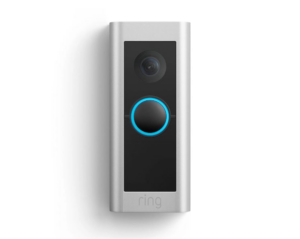
A video doorbell is a security camera specifically designed for your front door, providing a wide-angle view to capture footage of visitors, deliveries, or potential intruders.
This camera typically has a two-way audio communication system, allowing you to talk with guests through a smartphone app even when you’re not at home.
Most video doorbells come equipped with infrared night vision, motion detection, and weather-resistant features to ensure reliable performance and safety around the clock.
By offering real-time video streaming, alerts, and easy remote access, video doorbells make it simple to monitor your entryway and enhance the security of your home.
9. Fisheye Cameras

Fisheye security cameras use one very wide-angle lens. A ceiling-mounted model can provide a circular 360-degree room overview; a wall installation may use a 180-degree panoramic view.
A fisheye camera suits an overview of a shop, lobby or open room. Check the detail at the far edge of the scene before relying on it to identify a face: spreading pixels over a wide view reduces the detail available in a small area.
With advanced dewarping technology, the fisheye camera’s footage can be converted into a more traditional rectangle format, making it easier to view and analyze.
Additionally, the fisheye camera’s unique design aids in discreet surveillance, as it can be easily mounted on ceilings or walls and blend into its surroundings.
10. Spotlight Cameras

Spotlight security cameras, as the name suggests, are designed with an integrated bright LED spotlight to illuminate the area under surveillance.
While not as bright as floodlights, these cameras provide enhanced visibility during the night and deter potential intruders by casting a bright light on them when motion is detected.
As a result, not only do they capture high-quality footage even in low-light conditions, but they also actively contribute to the safety of your property.
Spotlight cameras often come with additional features such as two-way audio, customizable motion detection zones, and remote access via a smartphone app, ensuring you stay connected and informed about your home’s security at all times.
Related article: Best Outdoor Spotlight Security Cameras
11. Freestanding Cameras

Freestanding security cameras are typically designed for indoor use, offering users a versatile and easily adjustable choice for monitoring their homes or businesses.
These cameras stand independently, requiring no additional mounting hardware, making installation and repositioning a breeze.
With a wide range of features available, including motion detection, night vision, and two-way audio, freestanding cameras provide convenience and functionality for any security-conscious homeowner or entrepreneur.
12. LPR Cameras

License Plate Recognition (LPR) cameras are specifically designed to capture and identify vehicle license plates efficiently.
These cameras utilize advanced software algorithms to analyze the captured images, providing clear and accurate plate information even in varying lighting conditions or speeds of passing vehicles.
Often used in residential communities, parking lots, and business premises, LPR cameras enhance security measures by keeping track of vehicles entering and exiting the area, allowing for a proactive approach in deterring theft or unlawful activity.
Additionally, the data collected can be easily accessed and filtered for further analysis, making it a practical security solution for various environments.
13. Positioning Cameras

Positioning cameras use a motorized positioning unit for applications that need a large camera or lens to pan and tilt.
As an enhanced version of PTZ (pan-tilt-zoom) cameras, these feature rapid panning and tilting, coupled with serious optical zoom capabilities.
Some systems add object tracking or analytics, but these are model-specific features. Check the complete camera, lens and positioning-unit specification.
Long-range performance depends on the lens, sensor, lighting and the task. Detecting a distant object does not establish that you can recognize a person or read a plate at the same distance.
14. Multi-Sensor Panoramic Cameras

Multi-sensor panoramic security cameras provide a comprehensive view of your property, capturing images from multiple angles simultaneously.
These advanced cameras typically consist of 2-4 individual sensors that work cohesively to cover a wider area, reducing blind spots.
With their seamless panoramic visual coverage, these cameras distort images less and ensure that crucial details are sharp and clear.
Additionally, these cameras offer effective monitoring with low-light performance, making them ideal for safeguarding both indoor and outdoor spaces.
A multi-sensor panoramic security camera is a powerful and efficient solution for securing large areas or high-traffic spaces like parking lots, building perimeters, and commercial properties.
15. Corner Cameras

Corner security cameras are specifically designed to fit seamlessly into the corners of a room or space, such as elevators, providing comprehensive surveillance coverage with minimal blind spots.
Featuring a wide viewing angle, these compact cameras capture high-quality images even in confined spaces, ensuring the safety of occupants and deterring potential acts of vandalism or crime.
With their unobtrusive design and functionality, corner cameras have become an increasingly popular option for optimizing safety measures in both commercial and residential environments.
16. Thermal Cameras

A thermal camera, also known as a thermographic or infrared camera, offers a unique approach to security by detecting heat radiated from objects and people within its field of view.
Thermal imaging can detect heat in darkness and can help in smoke or light fog. Weather still affects range and contrast. It cannot see through ordinary window glass or solid obstructions, and vegetation can hide parts of a target.
Thermal cameras are useful for detecting a person or a hot area. They do not supply ordinary color footage for facial identification, and temperature measurement or fire alerts require a model designed for those tasks.
Often employed in high-security zones, critical infrastructure, and wildlife protection, thermal cameras have become an integral part of modern security systems due to their effectiveness and versatility.
17. Wall Light Cameras

The wall light security camera is an innovative combination of a standard outdoor wall light and a discreet video surveillance system.
This dual-function design not only provides energy-efficient illumination to your home exterior or yard space but also serves as a powerful monitoring tool.
Equipped with high-resolution sensors and night vision capabilities, the integrated camera captures clear footage in various light conditions while remaining unobtrusive.
Wall light security cameras can easily be connected to your smart home ecosystem, allowing you to seamlessly access live video feeds and receive instant notifications if any unusual activity is detected.
In addition to enhancing your home security, this versatile device adds a modern aesthetic touch to your property.
18. Wedge Cameras

Wedge security cameras, as the name suggests, have a wedge-shaped design which makes them visually unobtrusive and ideal for seamless mounting on walls or ceilings.
These compact cameras often come with features like wide-angle lenses, high-resolution video, infrared night vision capabilities, and weatherproof construction, making them suitable for both indoor and outdoor use.
By providing clear, detailed footage in various lighting and environmental conditions, wedge cameras are a popular choice among homeowners and businesses seeking discreet, yet effective, security surveillance solutions.
19. Hidden Cameras
Hidden cameras, also known as covert or spy cameras, are designed to blend seamlessly into their surroundings, going unnoticed in various environments.
These subtle devices come in an array of inconspicuous forms such as clocks, smoke detectors, and even everyday household objects.
Their discreet appearance enables homeowners and businesses to monitor activities without drawing attention to the camera’s presence.
Typically integrating with existing security systems, hidden cameras provide an extra layer of surveillance, capturing potential intruders or gathering crucial evidence in the event of illicit activities.
However, it is essential that users respect local laws and privacy concerns before installing these concealed devices.
20. Lightbulb Cameras

The Lightbulb Camera seamlessly combines security and everyday functionality by integrating a camera into an energy-efficient LED lightbulb.
This innovative design allows for discreet and convenient monitoring, making it an ideal addition to any home, office, or retail space.
Easily installed in a standard light socket, the lightbulb camera is often equipped with wide-angle lenses, high-resolution video capabilities, and motion detection sensors that send alerts to your connected device.
Additionally, it has infrared night vision to capture clear footage, even in low light conditions.
This versatile and unobtrusive camera provides an efficient solution for those looking to enhance their security without compromising on aesthetics or visibility.
Conclusion
Choose the camera category around the job: a clear fixed view of an entrance, a broad room overview, a close-up of a distant point, or heat-based detection.
These 20 labels are not mutually exclusive. A weather-rated bullet can use PoE, a freestanding camera can pan and tilt, and a panoramic camera can combine several sensors.
Key factors to consider when evaluating these cameras include image quality, range, field of view, night vision, connectivity, and durability.
Before buying, check power and cabling, recording access, the view at the required distance and night footage with a moving subject. A suitable housing is only one part of that choice.
For several directions that must stay recorded, plan continuous fixed or panoramic coverage. Add a moving camera when you also need an operator-controlled close-up.